PracticalThe route, bridge by bridge
What You See on a Seine River Cruise: Bridges and Monuments in Order
A one-hour cruise from the Eiffel Tower heads upstream first as far as the Île Saint-Louis, passes under about 20 of the 37 bridges in Paris, and goes by Chaillot, the Grand Palais, Les Invalides, Orsay, the Louvre, the Conciergerie and Notre-Dame, in that order, before turning back.
Eiffel Tower Port de la Bourdonnais · Metro: Champ de Mars – Tour Eiffel (RER C), Bir-Hakeim (6), Trocadéro (6, 9)
- Duration
- about 1h, no stops
- Bridges passed
- about 20 of the 37 in Paris
- Direction
- upstream first, turning near the Île Saint-Louis
- Farthest point east
- Pont de Sully, opposite the Institut du Monde Arabe
- Speed
- 12 km/h (7.5 mph) at most inside Paris
- Best seat
- upper deck, toward the back
Updated October 17, 2026Facts checked against official sourcesContains affiliate links
What you see from the Seine: what you can book
9 offers · Prices checked on October 17, 2026
Nothing with those filters.
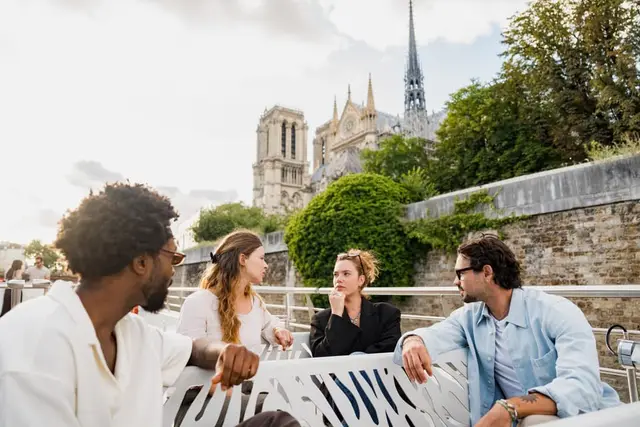
GetYourGuide1 hourEiffel Tower
Paris: Illuminations Seine Cruise starting from Eiffel Tower
4.3 (12,416)
from €18Check dates
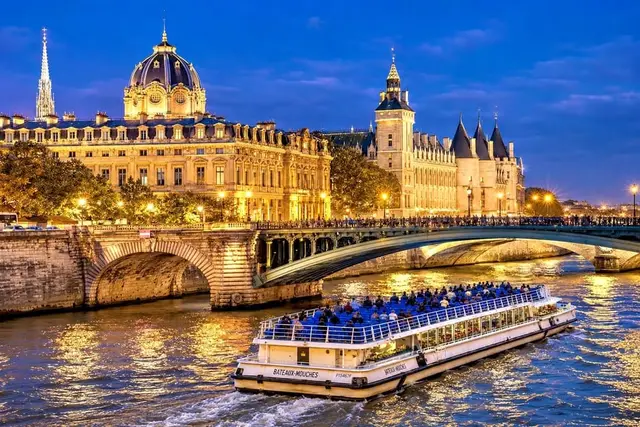
GetYourGuidePont de l'Alma
Paris: Bateaux Mouches® Sightseeing Cruise on the Seine
4.4 (6,150)
from €17Check dates
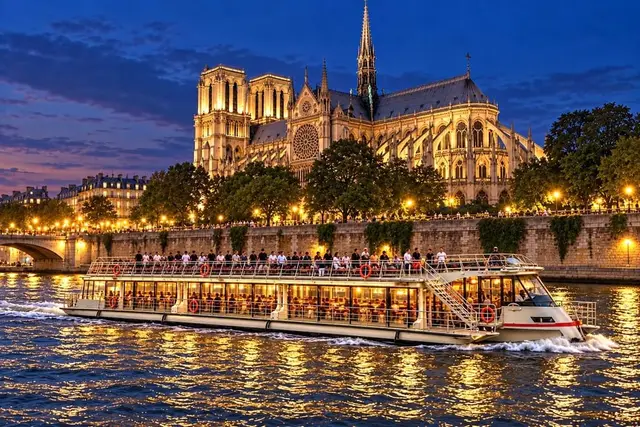
GetYourGuide70 minutes - 1.5 hoursPont de l'Alma
Paris: Evening Lights Cruise with Legendary Bateaux-Mouches®
4.3 (6,316)
from €17Check dates
GetYourGuide1 day
Paris By Night: Seine Sightseeing Cruise with Audioguide
4.2 (1,410)
from €18Check dates
TiqetsSuffren
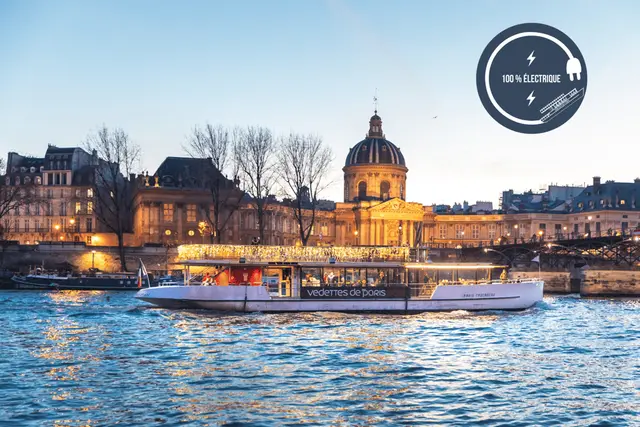
Seine River: Electric Boat Guided Sightseeing Cruise by Vedettes de Paris
4.4 (1,095)
from €18Check dates
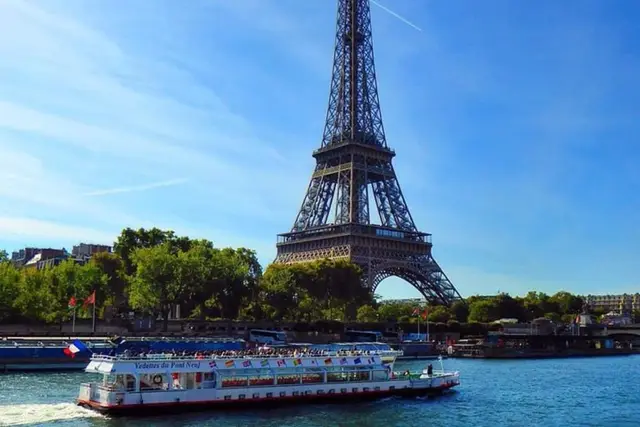
GetYourGuide1 hourPont Neuf
Seine River Sightseeing Guided Cruise Vedettes du Pont Neuf
4.6 (424)
from €17Check dates
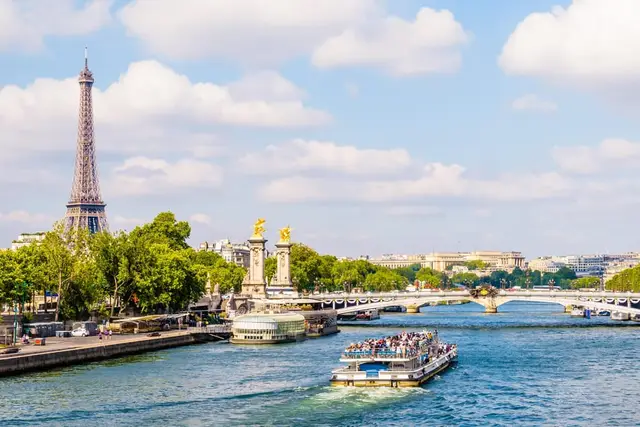
GetYourGuide1 hourPont de l'Alma
Paris: Bateaux Mouches® Day or Evening Cruise & Audio Guide
4.5 (62)
from €17Check dates
See everything on GetYourGuide →See everything on Tiqets →See everything on Headout →
The companies sell you a list of monuments; what actually matters is the order they come in, which side of the boat they are on, and which bridge you are under at that moment. This page follows a one-hour sightseeing cruise from the Eiffel Tower, like those of Bateaux Parisiens and Vedettes de Paris, or from the Pont de l'Alma for Bateaux Mouches: the run up to the islands, the turn, the way back. It also explains why boats do not all pass the same side of Notre-Dame, which bridges you really go under, what the loop never reaches, and where to sit so you miss nothing. To choose a company, see our one-hour Seine river cruise page; to go back to the start, the home page.
PierBridgeIsland
Why the boats head upstream first
From the Eiffel Tower (Port de la Bourdonnais and Port de Suffren) as from the Pont de l'Alma, one-hour cruises set off upstream, meaning east, against the current, toward Notre-Dame. They turn near the Île Saint-Louis, level with the Pont de Sully and the Institut du Monde Arabe, then come back down. Only Vedettes du Pont Neuf, which boards midway along the route at the tip of the Île de la Cité, does the reverse: it heads downstream to the Eiffel Tower first, then comes back around the islands.
The loop is not the companies' choice; it is the river's rules of the road. Around the islands, navigation rules impose one-way traffic: the bras de la Monnaie, the narrow arm that runs past Notre-Dame on the Left Bank side, is upstream only for boats under 60 m (about 200 ft); the bras Marie, on the Right Bank side of the Île Saint-Louis, is downstream only for passenger boats of the same size; and the main arm, between the Pont de Sully and the Pont au Change, works on an alternating system, one direction and then the other, hour by hour.
That has a consequence the brochures keep quiet about: which side of Notre-Dame your boat passes on the way out or the way back depends on the departure time and the size of the boat. No company promises you one arm rather than the other, and the captain may also change the route when the Seine is high. At 12 km/h at most, the speed limit inside Paris, you have plenty of time to watch the façades go by anyway.
From the Eiffel Tower to the Concorde: Chaillot, the Alma, the two Palais
The boat pulls away from the Left Bank quay with the Eiffel Tower behind you. Across the water on the Right Bank, beyond the Pont d'Iéna, stands the Palais de Chaillot, built for the 1937 Exposition, with the Trocadéro gardens. You pass the Passerelle Debilly footbridge, then, on the Right Bank, the Palais de Tokyo, another 1937 building, home to the Paris Museum of Modern Art and a contemporary art center.
Next comes the Pont de l'Alma, with the Zouave statue on its pier on the Right Bank: he is the city's folk flood gauge, and the bridge is where Bateaux Mouches boards. Then the Pont des Invalides and, right after it, the most photographed bridge in Paris, the Pont Alexandre III, built from 1896 to 1900: its arch is deliberately very flat so as not to block the view toward Les Invalides. Look right (to the Left Bank) along the line of the bridge: at the end of the esplanade rises the golden dome of Les Invalides, completed in 1708, under which Napoleon lies.
On the Right Bank, just upstream of the Pont Alexandre III, toward the Concorde, is the Petit Palais, with the Grand Palais behind it, both built for the 1900 World's Fair; what you mostly see is the Grand Palais's glass roof and its bronze chariots, set back from the river. On the Left Bank, facing the Pont de la Concorde, is the colonnade of the Assemblée nationale, France's lower house, added under Napoleon to mirror the Madeleine church. As you pass under the Pont de la Concorde, glance at the Right Bank: the Luxor obelisk, raised on the Place de la Concorde in 1836, appears in the gap in the quay.
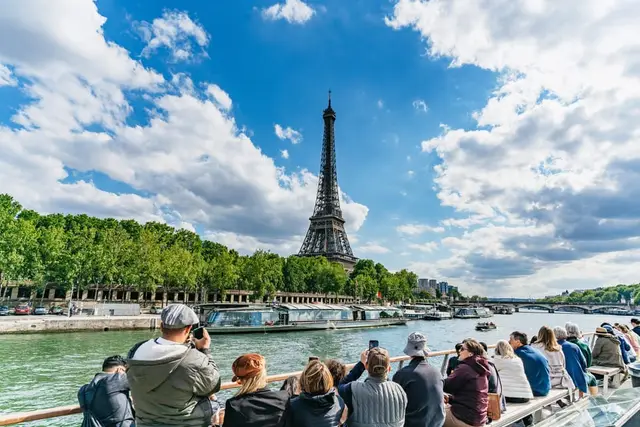
GetYourGuide1 hourEiffel Tower
Paris: Seine Cruise departing from the Eiffel Tower Web Rate
4.4 (91,857)
from €18Check dates
TiqetsSuffren
Seine River: Electric Boat Guided Sightseeing Cruise by Vedettes de Paris
4.4 (1,095)
from €18Check dates
GetYourGuide1 hourPont Neuf
Seine River Sightseeing Guided Cruise Vedettes du Pont Neuf
4.6 (424)
from €17Check dates
GetYourGuide1 hourPont de l'Alma
Paris: Bateaux Mouches® Day or Evening Cruise & Audio Guide
4.5 (62)
from €17Check dates
See everything on GetYourGuide →See everything on Tiqets →See everything on Headout →Prices checked on October 17, 2026
From Orsay to the Pont Neuf: the run of museums
After the Léopold-Sédar-Senghor footbridge, which links the Tuileries to the museum, the Musée d'Orsay fills the Left Bank: it is the former Gare d'Orsay railway station, built for the 1900 World's Fair and turned into a museum on December 9, 1986. Its two great clocks face the river. Opposite, on the Right Bank, is the Tuileries garden, then, from the Pont Royal (1689), the long façade of the Louvre, which stays with you as far as the Pont des Arts.
You go under the Pont du Carrousel, then under the Pont des Arts, the footbridge between the Louvre and the Institut. Its railings, heavy with love locks, were taken down on June 1, 2015 and replaced with glass panels; there is nothing left to photograph on that score. On the Left Bank, facing the bridge, is the Institut de France, the former Collège des Quatre-Nations, where the Académie française sits.
The boat then reaches the tip of the Île de la Cité and passes under the Pont Neuf, which, despite its name ("New Bridge"), is the oldest bridge in Paris: begun in 1578 and finished in 1607. At the tip lies the Square du Vert-Galant with its willows, right at water level, and the Vedettes du Pont Neuf pier. This is where the river divides, and where the route is decided by the rules described above.
Around the islands: Conciergerie, Notre-Dame, Hôtel de Ville
Along the main arm, on the Right Bank side of the Cité, the boat runs past the quai de l'Horloge and the round towers of the Conciergerie, what remains of the kings' medieval palace, a prison until 1934, where Marie-Antoinette was held in 1793. On the Right Bank, beyond the Pont d'Arcole, stands the Hôtel de Ville, Paris's city hall, burned during the Commune in 1871 and then rebuilt in neo-Renaissance style.
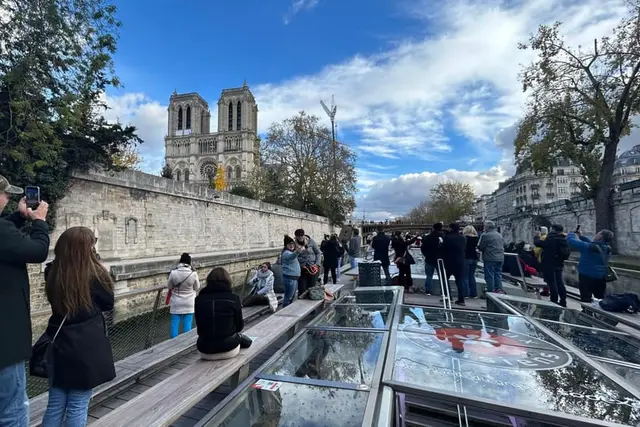
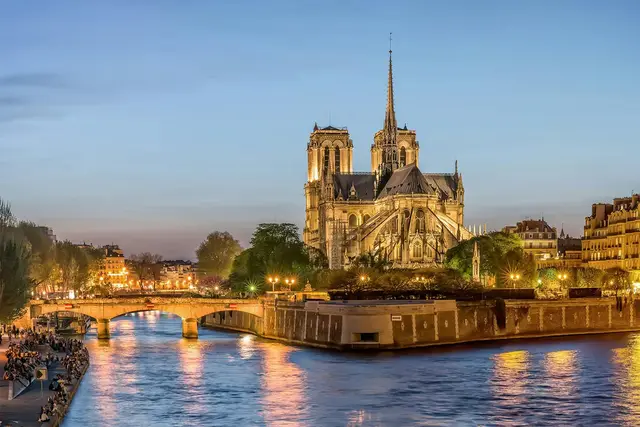
Along the bras de la Monnaie, on the Left Bank side, you pass closest to Notre-Dame, under the Petit-Pont and the Pont au Double, between the cathedral and the quai de Montebello. The cathedral has reopened since the 2019 fire. The finest view, in our opinion, is of the east end and its flying buttresses, between the Pont de l'Archevêché and the Pont de la Tournelle. On the Tournelle stands Paul Landowski's statue of Saint Genevieve, the city's patron saint, looking upstream.
Farther on, the Île Saint-Louis lines its quays with 17th-century mansions, linked to the Right Bank by the Pont Marie, completed in 1635, whose arches are all different. The boat turns level with the Pont de Sully, opposite the Institut du Monde Arabe on the Left Bank. On a clear day you can make out the towers of the national library far upstream: that is as close as a one-hour cruise gets to them. The way back takes the other arm and shows you the other side of the same monuments.
The bridges a boat really passes (and why not all 37)
Paris has 37 bridges over the Seine, from the upstream ring-road bridge at Bercy to the downstream one past the Pont du Garigliano, counting footbridges, rail viaducts and double-decker bridges. A one-hour cruise only goes under about 20 of them: it reaches neither Bercy nor the Pont Mirabeau.
Heading upstream from the Eiffel Tower: the Passerelle Debilly, the Pont de l'Alma, the Pont des Invalides, the Pont Alexandre III, the Pont de la Concorde, the Passerelle Léopold-Sédar-Senghor, the Pont Royal, the Pont du Carrousel, the Pont des Arts and the Pont Neuf. Then, around the islands, one set per arm: on the Right Bank side, the Pont au Change, the Pont Notre-Dame, the Pont d'Arcole, the Pont Louis-Philippe and the Pont Marie; on the Left Bank side, the Pont Saint-Michel, the Petit-Pont, the Pont au Double, the Pont de l'Archevêché and the Pont de la Tournelle. Then the Pont de Sully, at the turn. You pass one set on the way out, the other on the way back.
Downstream of the Eiffel Tower, the Pont d'Iéna, the Pont de Bir-Hakeim (two decks, with Métro line 6 running above the roadway), the Pont Rouelle and the Pont de Grenelle are only part of the route if the boat rounds the Île aux Cygnes, which the companies do not guarantee on the one-hour cruise. The table below lists all 37 bridges in the order of the current.
| # | Bridge | Current structure | Nearest pier |
|---|---|---|---|
| 1 | Pont amont | 1969 | |
| 2 | Pont National | 1853 | |
| 3 | Pont de Tolbiac | 1882 | Bercy |
| 4 | Passerelle Simone-de-Beauvoir | 2006 | |
| 5 | Pont de Bercy | 1864 | |
| 6 | Pont Charles-de-Gaulle | 1996 | Austerlitz, Rapée |
| 7 | Viaduc d’Austerlitz | 1904 | Austerlitz, Rapée |
| 8 | Pont d’Austerlitz | 1807 | Arsenal · Bastille |
| 9 | Pont de Sully | 1876 | Jardin des Plantes, Henri IV |
| 10 | Pont de la Tournelle | 1928 | |
| 11 | Pont Marie | 1635 | |
| 12 | Pont Louis-Philippe | 1862 | |
| 13 | Pont Saint-Louis | 1970 | |
| 14 | Pont de l’Archevêché | 1828 | Hôtel de Ville |
| 15 | Pont au Double | 1883 | Hôtel de Ville, Notre-Dame |
| 16 | Pont d’Arcole | 1856 | Hôtel de Ville, Notre-Dame |
| 17 | Petit-Pont | 1853 | Hôtel de Ville, Notre-Dame |
| 18 | Pont Notre-Dame | 1919 | Notre-Dame |
| 19 | Pont Saint-Michel | 1857 | |
| 20 | Pont au Change | 1860 | |
| 21 | Pont Neuf | 1607 | Pont Neuf |
| 22 | Pont des Arts | 1984 | Pont des Arts |
| 23 | Pont du Carrousel | 1939 | Louvre |
| 24 | Pont Royal | 1689 | Orsay · Solférino |
| 25 | Passerelle Léopold-Sédar-Senghor | 1999 | Orsay · Solférino |
| 26 | Pont de la Concorde | 1791 | Champs-Élysées |
| 27 | Pont Alexandre-III | 1900 | Invalides |
| 28 | Pont des Invalides | 1856 | Invalides |
| 29 | Pont de l’Alma | 1974 | Pont de l'Alma |
| 30 | Passerelle Debilly | 1900 | Debilly |
| 31 | Pont d’Iéna | 1814 | Debilly, Eiffel Tower |
| 32 | Pont de Bir-Hakeim | 1905 | |
| 33 | Pont Rouelle | 1900 | Île aux Cygnes |
| 34 | Pont de Grenelle | 1968 | Grenelle, Passy |
| 35 | Pont Mirabeau | 1896 | Javel |
| 36 | Pont du Garigliano | 1966 | |
| 37 | Pont aval | 1968 |
The way back, the Île aux Cygnes and the Statue of Liberty
On the way back the boat runs downstream along the other arm of the islands, past the Louvre, Orsay and the Grand Palais again, this time from the opposite side, then returns to its pier at the foot of the Eiffel Tower or at the Alma. In our view this is the best moment: the Eiffel Tower is straight ahead as the cruise ends.
Paris's own Statue of Liberty, about 11.5 m (38 ft) tall, stands at the downstream tip of the Île aux Cygnes, by the Pont de Grenelle. Put up in 1889, it was turned to face downstream in 1937; despite a stubborn legend, it does not "look toward" New York. Neither Bateaux Parisiens nor Bateaux Mouches promises it on their one-hour cruise, and the companies' own pages contradict each other on whether the boat rounds the island.
If you are set on seeing it from the water, choose a longer cruise that includes it on the route: the Bateaux Parisiens 12:45 pm lunches and 8:30 pm dinners, the Paris Seine dinners from Solférino, or the Capitaine Fracasse. Our Seine dinner cruise page compares their routes and piers.
What a one-hour cruise doesn't reach
Upstream, the cruise stops at the Pont de Sully. So it does not go as far as Bercy and the Accor Arena, or to the foot of the four towers of the Bibliothèque nationale de France, the national library, which you only see from a distance. Downstream, it does not go beyond the Île aux Cygnes: the Pont Mirabeau, the Maison de la Radio and the Pont du Garigliano stay out of reach. The longer loops of the Bateaux Parisiens lunches and dinners (12:45 pm and 8:30 pm), like the Capitaine Fracasse, go up as far as the library.
The route can also shrink. When the river floods, as measured on the Austerlitz gauge, the bras Marie closes to passenger boats at 2.50 m, the bras de la Monnaie at 3.00 m (so no close pass of Notre-Dame), and navigation through Paris is banned at 4.30 m: every cruise stops. This mostly happens in winter and spring, for a few days now and then.
In summer, from early July to the end of August, three supervised swimming spots open in the Seine: the bras Marie, the bras de Grenelle opposite the Île aux Cygnes, and the Port de Bercy. Boats pass without stopping, but the loops around the Île Saint-Louis and the Île aux Cygnes may be adjusted. On summer evenings the Olympic cauldron rises again above the Tuileries, and you can see it from the water.
Which side of the boat to sit on
Leaving the Eiffel Tower, the boat heads east, upstream. Facing forward, you have the Right Bank on your left (Chaillot, the Palais de Tokyo, the Grand Palais, the obelisk, the Tuileries, the Louvre, the Hôtel de Ville) and the Left Bank on your right (the Invalides dome, the Assemblée nationale, Orsay, the Institut de France). On the way back, everything swaps. Leaving from the Alma, on the Right Bank, the principle is the same, since Bateaux Mouches also heads upstream first; with Vedettes du Pont Neuf the order is reversed.
Since the side of Notre-Dame depends on the alternating system, our advice is simple: go up to the open upper deck, stand toward the back, where you can see both banks, and switch sides when you need to. The benches in the middle are the worst for photos. In rain or in winter, the heated cabin has big windows, but reflections spoil the pictures; step outside for a few minutes as you pass the Pont Neuf and Notre-Dame.
In the evening the Eiffel Tower lights up. The Eiffel Tower sparkles for five minutes at the start of every hour after dark, until at least 11 pm; on some evenings, especially in summer, it carries on later — check the tower's website for the day. A departure twenty to twenty-five minutes before the hour has a good chance of bringing you back toward the tower at the right moment, with no guarantee. See our Seine river night cruise page and the one on the Eiffel Tower sparkle; to find your quay, the Seine piers.
| Platform | Listing | Rating | Price | Where |
|---|---|---|---|---|
| GetYourGuide | Paris: Seine Cruise departing from the Eiffel Tower Web Rate · 1 hour | 4.4 (91,857) | €18 Lowest | See on GetYourGuide |
| Tiqets | Seine River: Cruise by Bateaux Parisiens | 4.3 (9,984) | €18 Lowest | See on Tiqets |
| Headout | Seine River 1-Hour Sightseeing Cruise from the Eiffel Tower | 4.7 (12,744) | €18 Lowest | See on Headout |
| Direct | Bateaux Parisiens, counter (€18 online) | — | €20 | Official site ↗ |
Lowest adult price per person in euros, checked on October 17, 2026. Times, menus and options can differ between platforms; check before you pay.
What do you see on a one-hour Seine river cruise?
In order from the Eiffel Tower: the Palais de Chaillot, the Palais de Tokyo, the Pont Alexandre III, the Grand Palais, Les Invalides, the Assemblée nationale, the Concorde, Orsay, the Louvre, the Institut de France, the Conciergerie, Notre-Dame, the Hôtel de Ville and the Île Saint-Louis, then the same monuments on the way back.
How many bridges do you pass?
About 20 of the 37 in Paris. The cruise goes neither as far as Bercy nor to the Pont Mirabeau.
Why does the boat head toward Notre-Dame and not toward the Statue of Liberty?
Cruises from the Eiffel Tower and the Alma head upstream first and turn near the Île Saint-Louis; around the islands, the arms of the river are one-way or alternate by the hour.
Will I see the Statue of Liberty?
Not with any guarantee on the one-hour cruise. The Bateaux Parisiens 12:45 pm lunches and 8:30 pm dinners, the Paris Seine dinners and the Capitaine Fracasse include it.
Which side of the boat should I sit on?
On the upper deck, toward the back. On the way out, the Right Bank (the Louvre, the Grand Palais) is on your left and the Left Bank (Les Invalides, Orsay) on your right; on the way back it is the other way around.
Do boats always pass the same side of Notre-Dame?
No. The bras de la Monnaie is one-way upstream, the bras Marie one-way downstream, and the main arm alternates by the hour: the side depends on the time and the boat.
Does the route change when the river floods?
Yes. Depending on the water level, the narrow arms close, and then all navigation stops at 4.30 m on the Austerlitz gauge.